


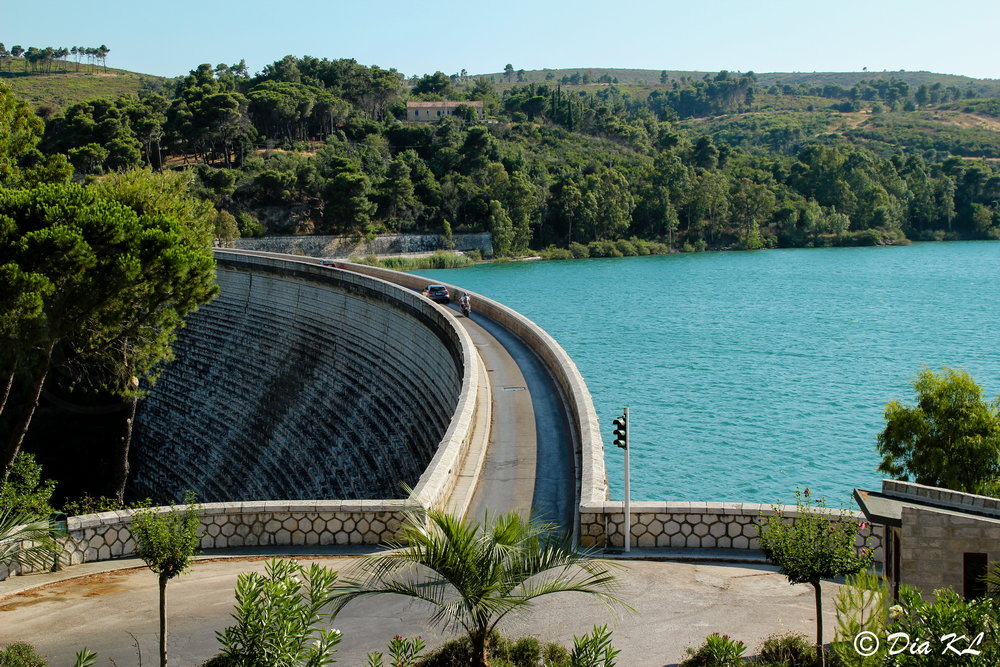
At the start of the 20th century, Athens had problems with the distribution of water. As the capital of Greece, the city’s population kept on growing and the taps and fountains which were distributing water were most of the times dry. In 1922, due to the Minor Asia disaster, there was a big population exchange between Greece and Turkey. An estimated 1.3 million refugees were returning and the population of Athens would end up doubling between 1920 and 1928. The water distribution problem of the city had to be solved.

The dam project was approved in 1923. In 1924, an American firm from New York city, Ulen & Company, was selected and signed a contract with the Greek government and the Bank of Athens to construct the dam. The project’s cost exceeded that of the National Bank of Greece and was funded with a $10 million loan to be repaid to Ulen.


The foundation stone for the dam was laid in October 1926. Pentelic marble was chosen as the main material of the dam (which was also the marble used to construct the Parthenon in the 5th century BC) and after three years, in 1929, the reservoir began to fill. Work on the dam and water network was completed in May 1931. Pipes with a total length of around 880km were placed all around Athens, Piraeus and the Attica vicinity. Through the Boyati Tunnel, 500 litres per second of water were going to the Galatsi Water Treatment Plant in Athens. The dam served as the primary water supply for Athens until 1959. By then, the population of Athens exceeded the capacity of the dam, so water was pumped into the Marathon lake from Yliki lake (around 62km northwest of the Marathon dam). But in 1981 the exploding population of Athens once again exceeded the capacity of both the two artificial lakes, so since 1981 most of the water for Athens has come from the artificial Lake Mornos with a 196km water transfer network.

Marathon dam is a gravity dam, meaning it is constructed of stone masonry and designed to hold back water by using only the weight of the material and its resistance against the foundation. It is 54 meters tall and 285 meters long. The artificial Marathon lake which was created has a maximum depth of 54 meters with a maximum water capacity of 41.000.000 m3.
I visited the dam by bicycle and since it was a long ride, I took a break at the nice cafe viewpoint at the north side of the dam, drinking a natural orange juice. And then I cycled through to the south side.


The dam is built at an altitude of 223 meters elevation and the road to take you back to Athens climbs a bit more, to 300+ meters altitude and from there you can have some beautiful panoramic views of the Marathon dam and lake.


Marathon dam and lake is not a must see attraction when visiting Athens, but if you are around for a longer period or live in Athens, it’s definitely worth to visit!
Additional information
GPS coordinates for places in this post, click on them to be redirected to the exact point in google maps Click on the names to be redirected to their official websites (if applicable).
Marathon dam : 38°10’01.7″N 23°54’20.2″E
Click below to read the connected related post:
Click on the categories at the top of the page or at the tags below for more posts!

